
Here is a question I hear from maintenance people all the time. “Oil mist lubricates the bearings. It never touches the mechanical seal. So how can it make our seals last longer?”
It is a fair question. Don Ehlert heard it so often that he answered it in Machinery Lubrication back in 2004. Plants would tell him they did not have bearing failures. Their real problem was seals.
The answer is simple once you see it. The bearing and the seal ride on the same shaft. What happens to one happens to the other.
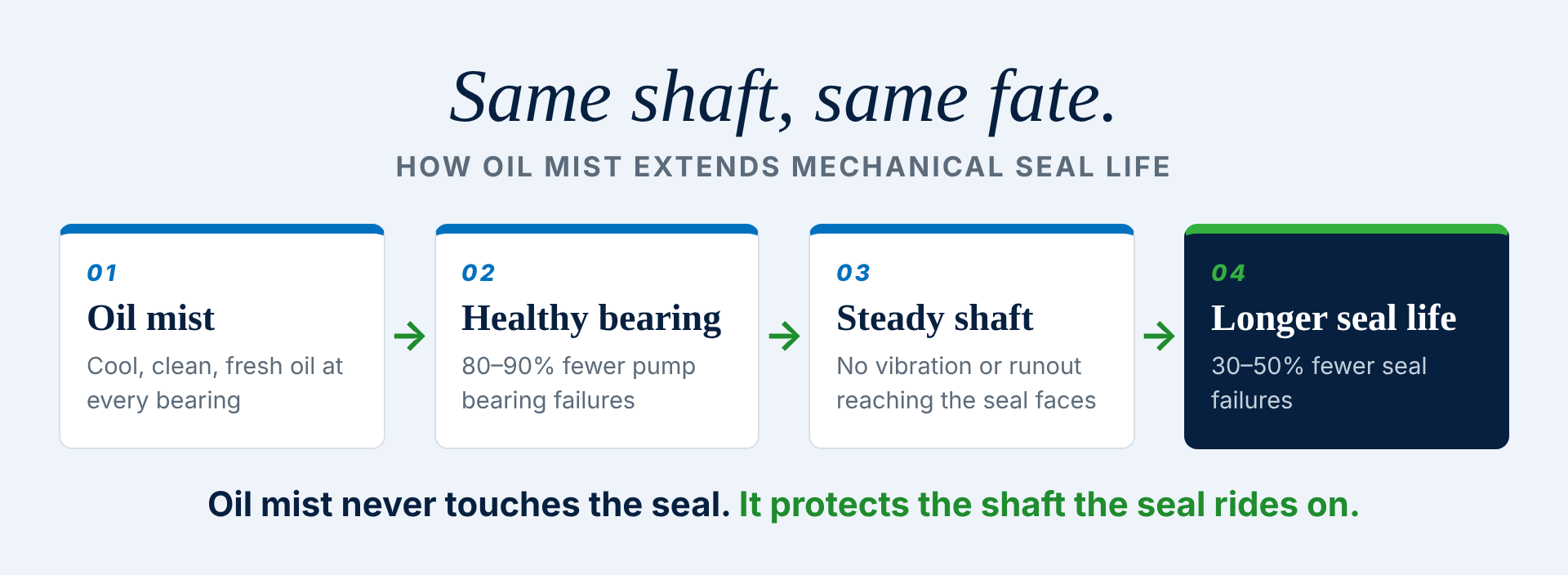
Same Shaft, Same Fate
A mechanical seal works by holding two flat faces together, one rotating and one stationary, with a very thin film between them. Those faces need a steady, centered shaft. They do not tolerate wobble, vibration, or a shaft that moves back and forth.
The bearings hold that shaft steady. When a bearing starts to wear, run hot, or lose its lubricant, the shaft starts to move. That vibration and runout travel straight to the seal faces. The faces open, chip, or wear unevenly, and the seal leaks.
So when the bearing goes, the seal often goes with it. Ehlert made the point plainly: everything affects the mechanical seal, so when bearings last longer, seals last longer.
How big is this effect? Stephen Flood reviewed about 11,000 mechanical seal failures from 148 plant sites over two years. About 13% of those seal failures started with a bearing problem. Heinz Bloch used those figures to estimate that about $416 million worth of mechanical seals are replaced every year because of pump bearing failures.
The Seal Failures That Are Really Bearing Failures
There is another reason this connection gets missed. When a pump comes into the shop with a leaking seal, the bearings are usually replaced at the same time. The work order gets coded as a seal failure. The bearing never gets the blame.
Ehlert noted that this is why bearing failures are under-represented in many plants’ MTBR numbers. When someone does a careful root cause analysis, they often find that a bearing problem caused the seal to fail. A refinery in the Pacific Rim published seal life comparisons that showed exactly this.
The lesson: if your plant thinks it has a seal problem, look at the bearings too.
How Oil Mist Protects the Seal
Oil mist does nothing magical to the seal. It protects the bearings, and the seal benefits. Here is how:
- Far fewer bearing failures. Pump bearing failures typically drop 80% to 90% with pure oil mist. Fewer bearing failures means fewer seals destroyed by a failing bearing.
- Cooler bearings. Pure mist bearings typically run 25°F to 35°F cooler than oil sump bearings. Every 10°F drop adds about 11% to bearing life.
- Always fresh, clean oil. There is no sump to collect water, wear particles, or degraded oil. The mist flow carries wear particles away, so the bearing never runs in dirty oil.
- Contaminants stay out. The slight positive pressure in the bearing housing keeps out moisture and dust, whether the pump is running or idle.
- No cooling water on the bearing housing. Pure mist lets you remove housing cooling water. As a pump heats up and grows, cooling water fights that growth and can preload the bearings.
- Spare pumps ready to run. Oil mist protects idle spares. Ehlert notes it is not uncommon for a pump to fail when operations switch from Pump A to Pump B. With oil mist, the spare starts on healthy bearings, and its seal is not put at risk on day one.
What the Published Data Shows
This is not theory. Users have tracked seal life before and after oil mist for decades:
- Bloch (2020): Mechanical seal failure events reduced by 30% to 50% with pure oil mist.
- Bloch (2020): One user reported average mechanical seal life doubled, to eight years.
- Bloch (2020): An overseas refinery compared itself to a sister plant without oil mist. MTBR doubled for both pumps and seals, and lubrication manpower was cut in half.
- Bloch (2020): A Pacific Rim refinery published seal life comparisons showing how bearing issues lead to seal failures.
- Ehlert (2011): User data shows seal failure reductions of 35% to 50%, worth about $410,000 a year in a 600-pump facility.
- Ehlert (2004): Lists fewer mechanical seal failures as a cost credit, alongside fewer fires and less chemical exposure.
Don’t Forget the Other Seal
Most pumps have two kinds of seals. The mechanical seal keeps the process fluid in. The bearing housing seal keeps the oil in and the contaminants out. Oil mist helps this second seal too, when it is applied correctly.
Since the 8th Edition of API-610, oil mist is dual-injected into the space between each bearing and its bearing housing seal. Bloch explained that when a face-type bearing protector seal runs with a thin film of clean oil between its faces, you get long seal life and near-hermetic containment. That combination makes closed-loop oil mist possible, with up to 99% of the oil recovered.
Put Seals in Your Cost Justification
Most oil mist justifications focus on bearings. That leaves money on the table. A seal failure costs more than the seal. It brings labor, process leaks, emissions, possible exposure to chemicals, and fire risk. In Ehlert’s 600-pump example, the seal savings alone came to about $410,000 a year.
One practical tip: code your failures honestly in the CMMS. If a bearing caused the seal to fail, record it that way. Otherwise neither the real problem nor the oil mist benefit will ever show up in your data.
What Oil Mist Cannot Fix
Oil mist will not fix a seal problem that does not start at the bearing. The wrong flush plan, dry running, misalignment, pipe strain, or a pump running far from its best efficiency point (BEP) all need their own fixes. Ehlert recommends keeping a pump that runs far from BEP on purge mist until it is re-rated. Oil mist removes one of the biggest seal killers. It does not replace good pump practice.
Conclusion
So does oil mist lubrication improve seal life? Yes. Not by touching the seal, but by keeping the bearings, and the shaft, healthy. Same shaft, same fate. The published data shows 30% to 50% fewer seal failures, and some plants have doubled their seal life.
If your plant is fighting repeat seal failures, I would be happy to talk through whether your bearings are part of the story. Feel free to reach out.
Sources and Further Reading
- Bloch, H.P. (2020). Oil Mist Lubrication History and Plant-Wide Reliability Experience — Pump Industry
- Ehlert, D. (2011). Getting the Facts on Oil Mist Lubrication — Texas A&M Turbomachinery Laboratory
- Ehlert, D. (2004). Oil Mist Lubrication in the Hydrocarbon Processing Industry — Machinery Lubrication
- Rehman, C. & Bloch, H.P. Oil Mist Lubrication for Pumps and Electric Motors — Machinery Lubrication
- Bloch, H.P. Pump Bearing Distress & Seal Failure: New Statistics on the Value of Bearing Housing Protection — Reliabilityweb
- Bloch, H.P. Bearing Isolators — AESSEAL Academy
- Bloch, H.P. & Shamim, A. Oil Mist Lubrication: Practical Applications. Fairmont Press.