
Ask a maintenance planner what it costs to change the oil in a cooling tower gearbox, and you will usually hear the price of a drum of gear oil. That is the smallest number on the bill.
By the time the job is done, the plant has paid for permits, a crane, scaffolding, a crew on the ground, a crew inside the fan stack, and the disposal of the old oil. It has also put people at height, in a confined space, under a suspended load, over a water basin.
This article walks through what one gearbox oil change really costs, shows how purge mist changes the math, and gives you a calculator to run the numbers for your own tower.
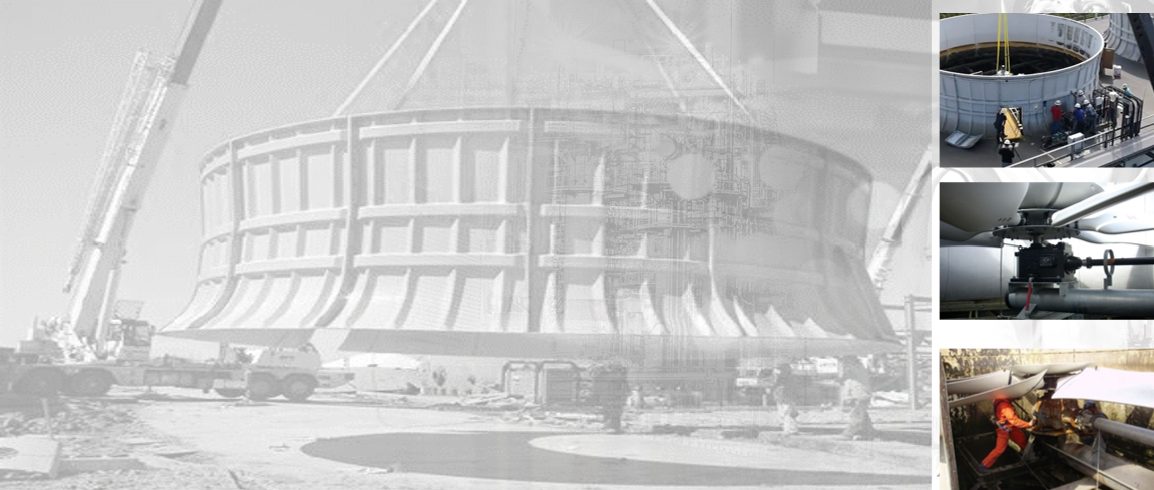
Why These Gearboxes Need So Much Attention
A cooling tower fan gearbox lives in one of the wettest places in the plant. Every time it heats up and cools down, it breathes. On the cool-down, it pulls saturated air from the fan stack in through the breather, and the water condenses in the sump. I once had a customer tell me the oil level in his gearbox rose about an inch a month from water alone.
Wet oil leads to rust, sludge, and pitting, so most facilities change it often. Don Ehlert noted that cooling tower gearbox oil is typically changed twice a year. With purge mist holding a slight positive pressure on the housing, he reported that interval stretching to once every two to three years, with oil sampling used to confirm the oil is still good. Many users report even longer intervals. He also pointed out why this matters so much on cooling towers: the location and the labor make every oil change expensive.
So the real question is not what the oil costs. It is what each trip to the gearbox costs, and how many of those trips you can eliminate.
What One Oil Change Really Takes
Here is what a typical cooling tower gearbox oil change looks like on the Gulf Coast. Your tower may differ, and the calculator lets you adjust for that. But most of these line items show up somewhere.
The Oil Itself
Right-angle cooling tower fan reducers commonly hold 10 to 30 gallons of oil, and larger refinery towers can hold more. Most facilities run a premium synthetic gear oil here. At 30 gallons and roughly $35 a gallon, the oil for one gearbox costs about $1,050. On a four-cell tower changed twice a year, that is eight fills and about 240 gallons a year.
Draining and Filling at Height
The gearbox sits at the center of the fan, inside the fan stack, above the fill. The old oil has to be drained into containers, and the gearbox is often flushed before it is refilled. All of this happens at height, over the basin, around fan blades that must be locked so they cannot windmill. The Combined Cycle Journal described one plant where crews had to isolate the cell, unbolt part of the fan shroud, rig a walkway to the gearbox, lock the fan, and tie off before they could even pull the fill plug. Just taking an oil sample took at least two hours a gearbox.
Cranes and Drums
New oil goes up, and old oil comes down. A full 55-gallon drum of gear oil weighs roughly 450 pounds. On many towers the only practical way to move drums, pumps, and flush equipment to the fan deck is a crane, with a qualified operator, a rigger, and a signal person. A crane mobilized for one gearbox is usually shared across the cells, but its cost still lands on the job. Every lift is a suspended load over people and over the basin.
People on the Ground, People Inside the Tower
This is not a one-person job. A typical crew includes two mechanics working inside the fan stack, an attendant or hole watch at the entry, a rigger on the ground, an operator to isolate the cell and verify lockout, and someone to write and manage the permits. Six people for a full shift on one gearbox is not unusual. At a fully burdened contract rate, the labor for a single oil change can easily run more than $4,500.
Permits to Get Inside the Shroud
Entering the fan stack or plenum generally falls under confined space rules. That means an entry permit, atmospheric testing, an attendant, a rescue plan, lockout/tagout on the fan motor and often the cell water, and fall protection. Each of these takes time from operations and safety personnel before a wrench ever turns.
Scaffolding
Many towers have no permanent platform to the gearbox. Scaffolding or a temporary work platform has to be erected inside the fan stack, inspected and tagged, and then taken down. Even a modest scaffold can add thousands of dollars to each oil change. If your tower has a permanent platform, enter zero for this line, and the other numbers still carry the case.
Disposal of Contaminated Oil
The oil that comes out of a cooling tower gearbox is often wet, emulsified, and full of wear metals. It leaves the site as waste, along with the absorbent pads, rags, and filters from the job. Every gallon you buy is a gallon you will pay to dispose of later.
The Risk of an Oil Spill
Oil changes are where spills happen. Hoses slip, drain valves stick open, and drums get knocked over, all at height, above a basin that feeds the plant’s circulating water system. A spill into the basin brings cleanup, reporting, and water treatment, and it can spread oil to every exchanger the tower serves. The Pennsylvania refinery case I have written about before is worth repeating: after purge mist went in, the gearbox failures stopped and the risk of an oil spill at the tower went to zero.
Safety: The Cost That Matters Most
Every oil change combines several of the highest-risk activities in a plant: work at height, confined space entry, suspended loads, lockout on rotating equipment, and wet, slippery surfaces. The National Safety Council puts the average cost of a medically consulted work injury at $48,000. No one wants to put a number on a person getting hurt, but every oil change you eliminate removes the exposure entirely. That is the best kind of safety improvement there is.
Putting a Number on It: A Four-Cell Example
Here is a worked example for a four-cell tower. The values are reasonable Gulf Coast assumptions, not quotes. Each one is labeled so you can swap in your own.
| Item | Example | Basis |
|---|---|---|
| New oil | $1,050 | 30 gal × $35/gal |
| Disposal of old oil and waste | $150 | 30 gal × $5/gal |
| Labor | $4,560 | 6 people × 8 hr × $95/hr |
| Crane | $1,500 | Operated crane day shared across cells |
| Scaffolding | $3,000 | Erect, inspect, dismantle |
| Permits, gas testing, rescue standby | $500 | Confined space, LOTO, fall protection |
| Spill risk (expected cost) | $500 | 2% chance × $25,000 |
| Injury risk (expected cost) | $480 | 1% chance × $48,000 (NSC) |
| Lost cooling / production | $0 | Left at zero to stay conservative |
| Total per gearbox oil change | $11,740 |
That is more than eleven times the cost of the oil. Now look at it over a year. Today, four gearboxes changed twice a year means eight oil changes. With purge mist and a conservative two-year interval, that drops to two oil changes a year for the whole tower.
| Today | With purge mist | |
|---|---|---|
| Oil changes per year (whole tower) | 8 | 2 |
| Oil change cost | $93,920 | $23,480 |
| Gearbox failures (0.5/yr × $50,000) | $25,000 | $15,000 (40% fewer) |
| Oil sampling (4/yr per gearbox × $150) | — | $2,400 |
| Mist oil and preventive maintenance | — | $2,000 |
| Total annual cost | $118,920 | $42,880 |
| Annual savings | $76,040 |
The bottom line. With an assumed installed cost of $60,000 to bring purge mist to the tower, the system pays for itself in about 9½ months. Over ten years, the net savings are about $700,000. Along the way, the facility avoids six oil changes, 12 drum lifts, 180 gallons of oil purchased and disposed of, and about 288 hours of high-risk work every year.
Even If You Ignore the Risk
Some people will push back on the failure, spill, and injury numbers. Fair enough. Take them all out. Count only the oil changes you no longer have to do, and subtract the sampling and mist upkeep. The example still saves about $60,000 a year and pays back in roughly twelve months. The case does not depend on the risk numbers. The risk numbers just make it stronger.
What the Field Has Already Shown
- A Pennsylvania refinery cooling tower. Before oil mist, one cell’s gearbox failed twice a year at about $50,000 per repair, driven by water getting into the oil. After purge mist, the failures stopped completely, the spill risk at the tower went to zero, and the system paid for itself in less than one year. That is a far more dramatic result than the conservative example above.
- Oil change intervals. Ehlert reported purge mist stretching cooling tower gearbox oil changes from twice a year to once every two to three years. Users report about 40% fewer failures in wet-sump equipment purged with oil mist, and oil change intervals growing by a factor of eight.
- Plant-wide credits. Heinz Bloch documented maintenance credits of as much as 95% over conventional lubrication at some major hydrocarbon processing facilities. Cooling towers are among the most expensive places in the plant to do routine lubrication, so they are among the best places to capture those credits.
Plug In Your Own Numbers
Every tower is different. The Cooling Tower Purge Mist ROI Calculator starts with the four-cell example above. Change any value and the cost per oil change, annual savings, payback, and ten-year return update as you type. An Excel version is also available if you would rather work offline.
A few tips for getting honest numbers:
- Pull the work orders. Look up the last few oil changes on your tower in the CMMS. Add up the labor hours, the crane and scaffold charges, and the waste tickets. Most facilities are surprised by the total.
- Count every cell, including the spares. Idle and seasonal cells breathe the most and often have the worst oil.
- Ask operations about lost cooling. The example leaves it at zero, but a cell down for a day in August can cost more than everything else on the sheet.
- Price the installation for your site. If an oil mist header already runs near the tower, the installed cost can be modest. A new generator dedicated to the tower costs more, but it can also pick up the fan motors and the cooling water pump motors in the pit.
Design It So You Do Not Have to Go Inside
Purge mist cuts the number of trips to the gearbox. Good design cuts the rest. Pipe the drain and oil sample points outside the fan stack, so routine sampling and level checks happen from the deck without a confined space entry. Size the gearbox vent at three to four times the reclassifier orifice so back-pressure does not give a false-high level in the sight glass. Collect the vented mist so it does not drift into the fan airflow or the basin. And remember that purge mist is a guard, not a lifeline. The sump level still has to be watched.
Conclusion
The oil is the cheapest part of a cooling tower oil change. The real cost is in the permits, the crane, the scaffolding, the crews on the ground and inside the tower, the waste, and the risk to people and the basin. Purge mist attacks every one of those costs at once, because it eliminates most of the trips. In the example here, that is worth about $76,000 a year on a four-cell tower and pays back in under a year. Run your own numbers. I think you will find the same.
If you would like help building the cost justification for your own cooling towers, I am happy to walk through it with you. Feel free to reach out.
The example values in this article are illustrative assumptions for a typical Gulf Coast cooling tower. Use your own facility’s costs before making a decision.
Sources and Further Reading
- Extend Asset Life with Oil Mist for Storage Preservation — Oil Mist Lubrication Institute
- My Oil Mist Lubrication Elevator Talk — Oil Mist Lubrication Institute
- Ehlert, D. (2011). Getting the Facts on Oil Mist Lubrication — Texas A&M Turbomachinery Laboratory
- Towne, C. (1994). Oil Mist Lubrication for the Petrochemical Industry — Texas A&M Turbomachinery Laboratories
- Bloch, H.P. & Ehlert, D. (2008). Get the Facts on Oil Mist Lubrication. Hydrocarbon Processing.
- Bloch, H.P. & Shamim, A. Oil Mist Lubrication: Practical Applications. Fairmont Press.
- Cooling-tower fan gearbox mod facilitates oil sampling, recharge — Combined Cycle Journal
- Mobil Productivity Pointer: Cooling Towers — ExxonMobil
- Work Injury Costs — National Safety Council, Injury Facts