
Independent • Vendor-Neutral • 50 Years of Experience
Advancing Oil Mist Lubrication Technology
The Oil Mist Lubrication Institute provides unbiased training, technical guidance, and industry best practices so operators can apply this proven technology correctly and get the reliability, cost, and environmental results it was designed to deliver.
160,000+Process pumps worldwide lubricated solely by oil mist
87–90%Bearing failure reduction with properly designed systems
~50%Of U.S. refineries use oil mist lubrication extensively
< 2 yrsTypical payback period for a properly installed system
Our Mission
Unbiased. Non-Commercial. Technology-First.
The Oil Mist Lubrication Institute promotes the unbiased, non-commercial advancement of oil mist lubrication technology. Through training, technical guidance, and industry best practices built on 50 years of field experience, we help operators apply this proven technology correctly and get the reliability, cost, and environmental results it was designed to deliver.
Vendor-Neutral
We don't manufacture or sell oil mist equipment. Our guidance serves one interest only: the correct application of the technology.
Field-Proven Knowledge
Our body of knowledge is built on decades of installations, surveys, and troubleshooting across refineries, petrochemical plants, and power facilities worldwide.
Standards-Based
Grounded in API-610 and the published literature of Bloch, Towne, and Ehlert, the foundational authors of the technology.
Root-Cause Focused
Early failures blamed on "oil mist" were almost entirely installation and distribution errors. We teach the why, not just the what.
Why Oil Mist
A Proven Reliability Strategy, When Applied Correctly
Oil mist has been the predominant pump lubrication method in U.S. refining for decades. Properly designed systems deliver documented, repeatable results:
15–30°F coolerBearing temperature reduction vs. grease. Every 10°F drop adds ~11% bearing fatigue life.
4–6 year MTBFRoutinely achieved on pumps; 10+ years on record at best-practice facilities.
75% less oilDual-point injection per API-610 vs. legacy center injection. All oil does useful work.
90% of motor failuresAre caused by grease lubrication. Oil mist directly addresses the dominant failure mode.
99% oil recoveryClosed-loop systems are designated Best Available Technology for process equipment lubrication.
Continuous protectionSlight positive pressure excludes water and particulates, so bearings are protected even at standstill.
Training & Knowledge Transfer
Training for Every Role in the Plant
Oil mist systems need minimal but essential maintenance, never "set and forget." We build competency at every level, from the daily operator round to the reliability engineer's conversion study.
Operator Training
The 5–10 minute daily routine that keeps systems healthy.
Daily inspection: normal vs. abnormal indicators
Reservoir refilling and contamination prevention
Alarm response and escalation
Safety: LOTO, hot work, mist exposure limits
Maintenance Technician Training
System theory, systematic diagnosis, and hands-on component service.
Mist generation, distribution, and reclassifier function
Troubleshooting common failure modes to root cause
Reclassifier service, fittings, seal inspection
Piping modifications: materials, velocity, slope
Mechanical Training
Hands-on equipment conversion of pumps and electric motors to pure mist.
Pump conversion: dual-injection per API-610, drain-back port plugging
Motor conversion: complete grease removal, seal and drain protocols
Reclassifier selection and service factor sizing
Before/after temperature and vibration verification
Engineering & Reliability Training
Design, specification, and optimization for reliability professionals.
System sizing, oil selection, distribution design
Grease-to-mist and sump-to-mist conversions with ROI
API-610 standards compliance
CMMS integration and performance tracking
Technical Services
Field Surveys, Audits & Expert Guidance
Independent assessment of your oil mist systems against API standards and industry best practices, with actionable findings, not sales pitches.
System Surveys & Audits
Documentation review: P&IDs, schematics
Generator capacity vs. load, heater and oil verification
Distribution survey: slope, velocity, leak evidence
Injection method verification (dual vs. center)
Vent, collection, and environmental compliance
Troubleshooting & Problem Diagnosis
Reclassifier plugging and wax precipitation events
Lubrication related bearing failures and distribution faults
Stray mist and environmental issues
High bearing temperatures and mist delivery faults
Root-cause analysis: fix it and prevent recurrence
Design & Conversion Guidance
New system specification and generator sizing
API-610 compliant dual-injection design
Grease-to-mist motor conversion protocols
Oil selection: paraffin-free, correct viscosity
Closed-loop system evaluation
Technical Resources
Resources
Field-ready articles, and the peer-reviewed foundation our guidance is built on.
Oil Mist 101: The What, Why and Where
By Keith Macaluso, CRL
A plain-language introduction to what oil mist is, how it protects bearings, and why it matters for plant-wide reliability.
Oil Mist Lubrication is “Free”
By Keith Macaluso, CRL
Why oil mist typically pays for itself within 18 months by eliminating rust, downtime, and unplanned maintenance on critical rotating equipment.
Extend Asset Life with Oil Mist for Storage Preservation
By Keith Macaluso, CRL
How oil mist protects new pumps and motors while they wait in storage, preventing rust and premature failure before installation even begins.
The Published Foundation
Our guidance is grounded in the peer-reviewed papers and industry publications that established oil mist lubrication as a plant-wide reliability strategy.
Bloch, H.P. (1980). "Large Scale Application of Pure Oil Mist in the Petrochemical Plant." ASME Paper 80-C12/LUB-25.
Towne, C. (1983). "Practical Experience with Oil Mist Lubrication." Lubrication Engineering, Vol. 39, pp. 496–502. ASLE.
By Keith Macaluso, CRL, The Oil Mist Lubrication Institute
I often assume that people know what I mean when I talk about my work. Recently, I was talking with someone about Oil Mist Lubrication. I talked about the subject for a while. Then the listener asked, “Is that oil mist for machining parts?” This question made me think. How many people really understand Oil Mist Lubrication when I write about it on LinkedIn? I need a short elevator speech about the what, where, and why of Oil Mist Lubrication?
What is oil mist? Oil mist is a mixture of air and oil. It looks like cigarette smoke. But this mist is cool, dry, and free of contaminants. A bearing needs the correct type, quantity, quality, location, and time of lubrication. We call these the five “Rights” of lubrication. Oil mist gives a bearing all five Rights. This creates the perfect environment for a long bearing life.
The oil mist ratio — roughly 1 part oil to 200,000 parts air: lean, non-combustible, safe, and low pressure.
A generator in one central location combines the oil and the air. This generator creates very small particles, only a few microns in size. Oil mist at this size can travel long distances, up to 1000 feet. But this dry mist cannot lubricate a bearing by itself. At the bearing, the oil mist passes through a reclassifier. A reclassifier is a small device with an orifice, or opening. The reclassifier gives the correct amount of oil mist to the bearing. It also causes the oil particles to collide and combine. This wets the bearing surface for lubrication.
Where do you lubricate with oil mist? The oil mist enters the bearing housing and flows through the bearing. You no longer need an oil sump, an automatic oiler, or a slinger ring. We call this method “pure mist.” In pure mist, oil mist is the only source of lubrication for the bearing. But some bearings still need an oil sump. Examples are journal bearings (metal-to-metal) and the gears inside a gearbox. For this equipment, we use a method called “Purge Mist.”
For electric motors, we remove the grease fitting and all the grease. Then we apply oil mist instead. We also purge mist other equipment, such as cooling tower gearboxes.
Why do hundreds of thousands of pumps and motors worldwide use oil mist lubrication? Here are the benefits:
Up to 90% fewer bearing failures caused by lubrication.
Users report 40% fewer failures in wet-sump equipment purged with oil mist. Oil change intervals also increase by a factor of 8.
A large reduction in seal failures.
Less oil usage.
Better storage preservation. Oil mist continually purges standby equipment. This keeps the bearing ready for service.
There is more to say about oil mist. I tried to keep my elevator speech to 150 words or less. I could not do it. But this is my best attempt to explain the technology well.
Contact me for more information about Oil Mist Lubrication. I can show you how it can work for you. Visit my website www.theoilmistinstitute.org
Oil Mist Lubrication is “Free”
How Oil Mist Systems Improve Reliability
By Keith Macaluso, CRL, The Oil Mist Lubrication Institute
Overview
Today, everyone must watch costs closely. So it makes good economic sense to avoid repairs and downtime on critical equipment, such as pumps, electric motors, and gearboxes. Sometimes, new equipment sits outdoors in a laydown area before installation. There, simple moisture can reduce the value of your investment. This is why I say oil mist lubrication is basically “free.” It is free from rust. It is free from extra maintenance. It is free from downtime that costs you money. On average, this solution pays for itself in 18 months or less. After that, it continues to save you money again and again. That is a great return on your investment!
Oil Mist Lubrication Benefits
If you apply oil mist proactively, your worries are over. The concept is simple. Oil mist uses only oil and air. It produces a mist that coats your equipment evenly and continuously. It reaches the interior surfaces and cavities where moisture causes corrosion. This is very important along the Gulf Coast.
The best users have proven that oil mist lubrication can:
Reduce bearing failures caused by lubrication.
Reduce seal failures.
Reduce oil usage.
Increase the life of pumps and gearboxes.
Reduce early machinery failure. Oil mist protects standby and idle equipment in storage.
This chart shows that lubrication is a leading cause of bearing failure:
Source: The Most Common Causes of Bearing Failure and the Importance of Bearing Lubrication — Bearing News (bearing-news.com), March 17, 2020.
Conclusion
Oil mist lubrication systems bring big returns. Yes, there is an upfront cost to buy a system. But the value of improved equipment reliability is priceless. Do not let new or stored equipment lose its effectiveness before installation. Act today. Make sure your machinery runs smoothly, reliably, and for a longer time.
For more information, visit www.theoilmistinstitute.org
Extend Asset Life with Oil Mist for Storage Preservation
New equipment requires special care while awaiting installation
By Keith Macaluso, CRL, The Oil Mist Lubrication Institute
Lead times for new equipment are long today. Supply chains are also not reliable. To keep operations running, petrochemical and refining plants order new pumps and motors a year or more before they need them. When the equipment arrives early, workers usually store it in an open field. There, it is open to weather and other harmful conditions. This can damage the equipment before it is even installed. So, correct storage of this standby equipment is very important. Good storage prevents early failure at start-up. It also helps to increase the mean time between failures (MTBF).
Oil Mist Technology – How it Works
Oil mist technology can protect new equipment while it waits for installation. Oil mist is a mix of air and oil. It is cool, dry, and free of contaminants. Workers apply oil mist to moving parts, such as bearings, to make them last longer. A generator combines the oil and the air in one central location. This generator makes very small particles. The small particles can travel long distances, up to 600 feet in any direction. When the mist reaches the bearing, it passes through a device called a “reclassifier.” The reclassifier turns the dry mist into a wet mist for lubrication. Some parts, such as the gears in a gearbox, still need an oil sump. For these parts, we use a method called “purge misting.” Oil mist can work with almost any pump or motor type.
Case Study – Oil Refinery, Northeast USA
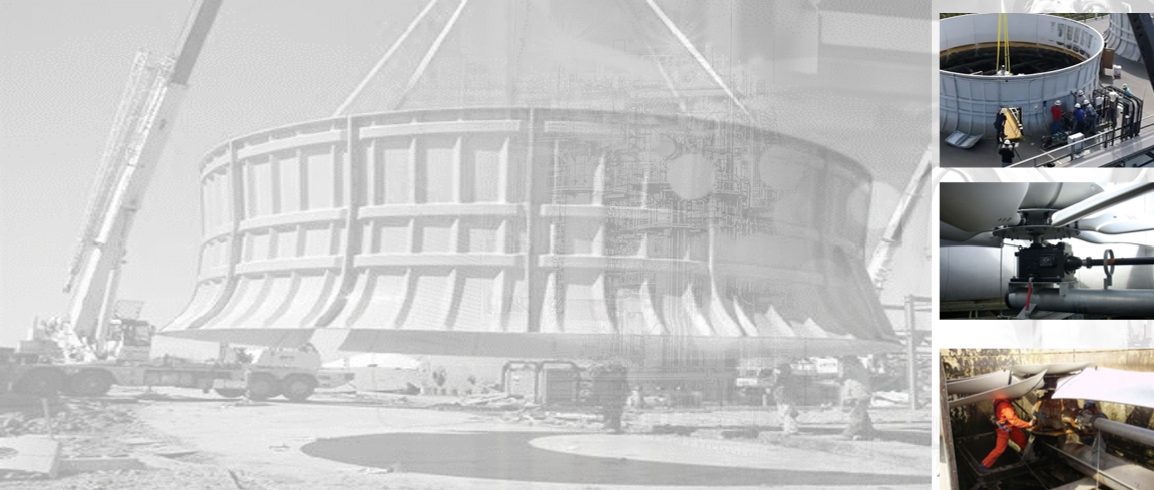
Oil mist lubrication systems are useful in standby mode and during normal operation. Here is a real example. A refinery in Pennsylvania installed an oil mist lubrication system on a cooling tower. The system paid for itself in less than one year. Before the system, the cooling tower gearbox failed two times each year. Each failure cost $50,000 to repair. After the system, these failures stopped completely. The system also reduced the risk of an oil spill to zero. Water had been entering the gearbox and causing erosion, rust, and sludge. The oil mist system stopped this water contamination.
Typical cooling tower gearbox setup with oil mist lubrication system.
Conclusion
The best-in-class facilities know the value of oil mist lubrication. These facilities have high equipment reliability and high profits. They add oil mist lubrication to their routine maintenance program. They apply it to all machines, whether running or in storage. Without oil mist, facilities must rely on just-in-time repairs. Over time, this lets equipment rust and decay.
For more information, visit www.theoilmistinstitute.org
Put 50 Years of Experience to Work
Whether you're planning a conversion, troubleshooting a system, or building operator competency, start with an unbiased conversation.